Showing posts with label Smarter Investing in Any Economy. Show all posts

Sunday, April 17, 2011

Relative Strength Investing Weekly Update April 17th

In the Smarter Investing Relative Strength Portfolio I'm running, I had 2 stop outs. One was in IYE, and the other was in IWR.

New buys to be placed for Monday are:

Asset Allocation Portfolio - IAU - I cringe a little at this one but the rules say buy so I buy.

Sector Allocation Portfolio - IYE - Just got stopped out but it's the number one rank. The whipsaw is a little costly since I missed the rally in it on Friday.

I am torn about using stops with this portfolio for a number of reasons. Whipsaw is the primary one.   I decided I would try to follow the plan that Michael Carr put forth in his book Smarter Investing in Any Economy which uses stops. I will keep to this plan and see how it works moving forward. The portfolio should beat the market regardless and will have a much lower draw down than other relative strength investors are probably used to.

I have , however, been doing some more research and put together a method which would not be using stops has a less frequent updating time and is easier to implement. The testing results look good and I'm about ready to go forward with it soon. I plan to put out a post with my test results. I'll also at some point put together some more systematic way to track results. The nice thing is that I can run an unlimited number of portfolios in foliofn and run them independently all free of commission during their trade windows.

The method for calculating relative strength used in this portfolio is the ratio of multiple moving averages. Carr's back testing goes further back than historical etfs since he used mutual fund data and I'm confident in his testing methods. I wish I could duplicate them, but my trading / back testing software cannot make relative strength comparisons between different markets. Check older posts for more details on this method.

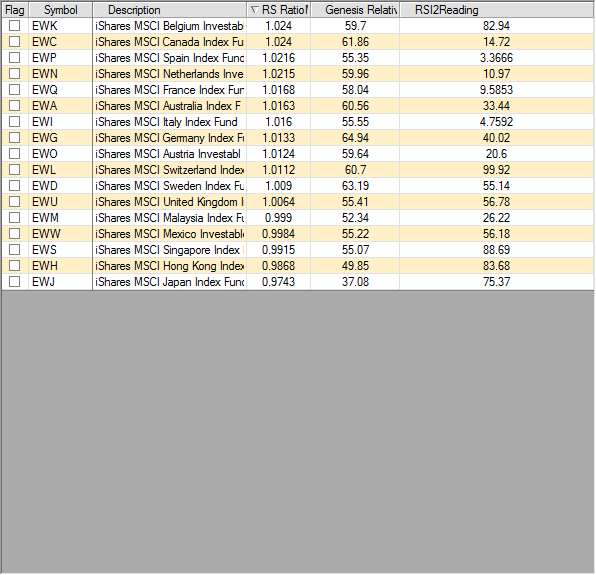
The column for the relative strength multiple moving average is the center one that starts with RS.

Sunday, April 3, 2011

Smarter Investing in Any Economy The Definitive Guide to Relative Strength Investing Review


One of the etf investing strategies I am currently using is Relative Strength. Basically relative strength investing invests in the strongest performing etfs or stocks. The idea is that those sectors that have been performing the strongest in the past will continue to perform strong in the current year.

The book Smarter Investing in Any Economy The Definitive Guide to Relative Strength Investing,  by Michael Carr,is a comprehensive study of this method with thorough back testing and results to support it. If you are interested in this subject, this book is a must read. 

The book begins by discussing why relative strength investing works. People tend to pile into markets that have performed well creating trends. Carr provides many references to studies on trend following and the results which support relative strength investing.

Carr then proceeds to explore and test 9 methods in detail for calculating relative strength. Carr gives the formulas and back testing results for each method. This research alone would be worth the price of the book since back testing relative strength strategies is very difficult to do. All 9 methods for calculating relative strength out performed the S&P 500 which supports the robustness of this strategy. 

Carr then selects the strategy he felt had the best risk reward. He works on optimizing this strategy, but is very careful and aware of data mining and over optimization. You can be confident his optimization work is reliable as his results provide a wide range of profitability and selecting a range of inputs will still beat the S&P 500. 

One of the qualities that sets this book apart from most is the risk analysis, and the extra steps Carr takes to reduce risk in the relative strength method. The problem with relative strength investing is that, though it out performs when the market is going well, it can decline much steeper than the overall market when it begins to fail. You can give back all of your precious gains very quickly if you do not have risk management in your system. The method will rotate you out of the under performing sectors but without risk management you can suffer significant draw downs in a relative strength strategy. Carr advocates the uses of trailing stops which do reduce profits, but they reduce draw downs. Another area of risk reduction is diversity by using etfs, and a balance of asset classes. He provides 3 sets of etf groups and runs the strategy on these 3 etf groups which helps reduce the overall risk. He also uses an equity curve. The overall result is a significant reduction in draw down with a fairly minimal impact on profits. 

This book covers all of the bases on relative strength investing and is simply a must read on this strategy. I haven't come across many books that were so easy to read yet  packed with so much information.